Agentic RAG vs. Basic RAG vs. Traditional AI
Published by Spinutech on September 21, 2026
AI can write an email, summarize a document, answer a question, or help brainstorm an idea in seconds.
But ask it a question specific to your organization — about an internal policy, technical spec, customer account, product guide, or proprietary process — and the challenge changes.
You need more than a good answer.
You need the right answer, based on the right information.
That's where the differences between traditional generative AI, retrieval-augmented generation (RAG), and Agentic RAG become more important.
All three can generate answers. But they differ significantly in what they know, how they find information, and how reliably they can turn organizational knowledge into something useful.
Traditional AI: Powerful, But Limited to What It Knows
Generative AI tools powered by large language models (LLMs) excel at understanding and generating language.
Give one a prompt and it can draft content, summarize information, brainstorm ideas, explain concepts, and perform countless other tasks.
For general-purpose productivity, that's incredibly valuable.
The challenge is context.
An LLM's underlying knowledge primarily comes from its training data and whatever information is supplied as part of the interaction. On its own, it doesn't automatically know what's contained in your organization's product documentation, knowledge bases, policies, support materials, or other proprietary sources.
That creates a gap between general intelligence and organizational knowledge.
For example, ask a traditional AI tool:
“What is our company's policy for approving this type of customer refund?”
Without access to your organization's current policy, the model may not have the information required to provide a reliable answer, leading it to hallucinate an answer to satisfy the query.
Traditional AI is good at generating answers. It isn't inherently designed to know your business.
Basic RAG: Give AI Access to Your Knowledge
RAG addresses the limitation of traditional AI by connecting an LLM to external information.
Instead of relying exclusively on what the model already knows, a RAG system searches an organization's indexed content for information relevant to the question. It then provides that information to the LLM as context for generating its response.
The basic process looks like this:
Ask ? Retrieve ? Generate
Someone asks a question, the system searches the available knowledge, relevant information is retrieved, and the LLM uses it to generate an answer.
That can dramatically increase the usefulness of AI for enterprise applications because answers can be grounded in current, organization-specific information rather than generalized model knowledge.
Imagine an employee asks:
“What is our company's policy for approving this type of customer refund?”
Basic RAG can search the organization's policy library, retrieve the section addressing refund approvals, and provide that information to the LLM.
Now the AI has something it didn't have before: Your context.
Agentic RAG: When Finding the Answer Requires More Work
Consider a more complicated question:
“How does our current refund policy differ for enterprise customers, and have the requirements changed since last year?”
Now one retrieval may not be enough.
The system may need to:
- Identify the current refund policy
- Determine which rules apply specifically to enterprise customers
- Locate the previous version
- Compare the two
- Determine what changed
- Verify that the final answer is supported by the source material
Traditional RAG generally follows a fixed retrieval path. It searches once and generates an answer based on what it finds.
Agentic RAG can determine that more work is required.
It introduces AI agents into the retrieval process that can plan how to approach a question, break complex requests into smaller tasks, select appropriate information sources, refine searches when the first results aren't sufficient, and validate answers against available evidence.
The process becomes less like:
Ask ? Retrieve ? Generate
and more like:
Ask ? Plan ? Search ? Evaluate ? Search Again if Needed ? Validate ? Answer
That's the important difference.
Basic RAG retrieves knowledge. Agentic RAG can reason through how to retrieve and use it.
Traditional AI vs. Basic RAG vs. Agentic RAG
The differences become clearer when you look at what each approach is designed to accomplish.
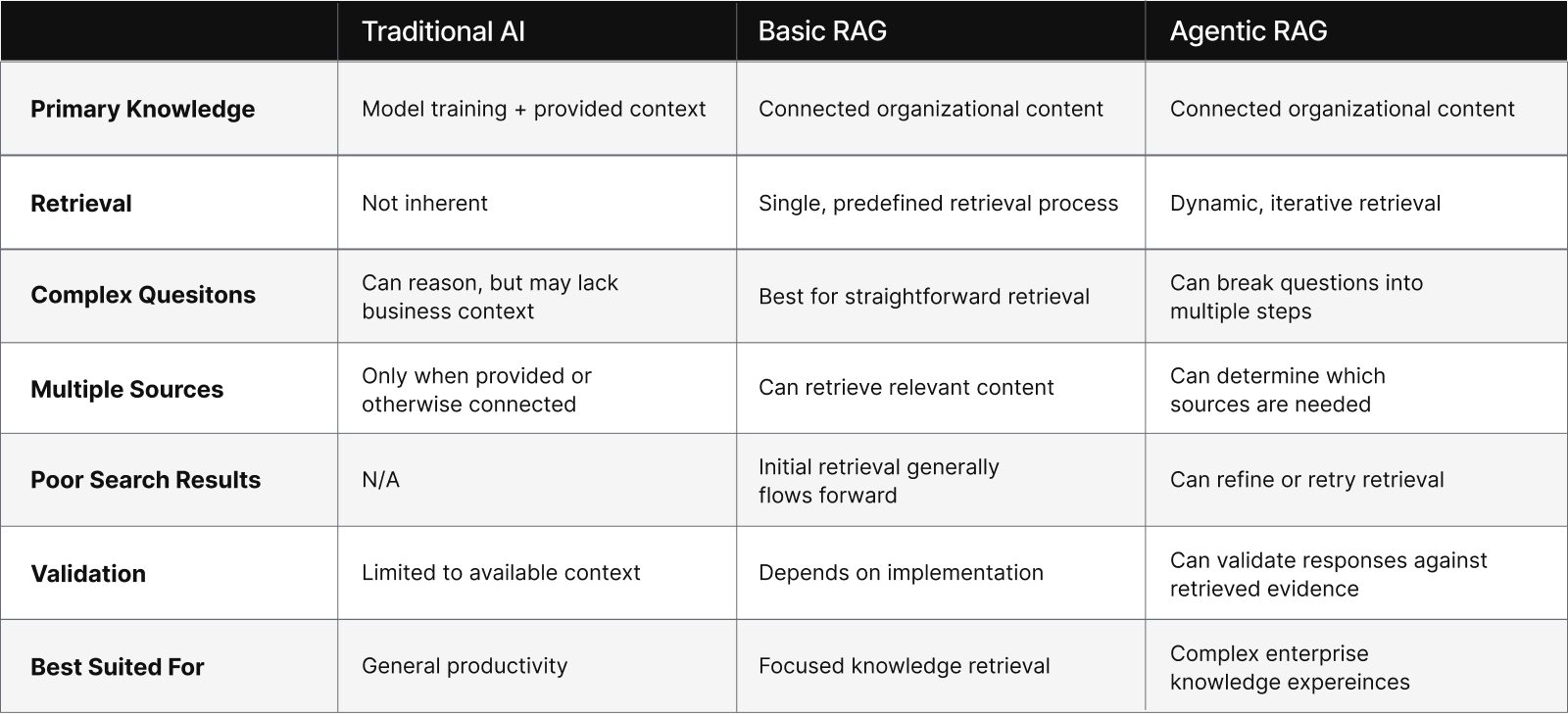
The point isn't that every organization should replace every AI application with Agentic RAG.
The right approach depends on what you're asking AI to do.
Where Progress Agentic RAG Changes the Equation
The value of Agentic RAG isn't simply that it can retrieve information. It's that it can take a more dynamic approach to finding, evaluating, and using the right information to answer a question.
Progress Agentic RAG brings capabilities such as query rewriting, intent routing, semantic reranking, multi-source retrieval, retrieval agents, and question decomposition together within an enterprise platform. These capabilities allow the system to break down complex questions, determine which sources to use, and retrieve the context needed to generate an answer.
But generating an answer is only part of the equation. Organizations also need a way to understand how well their RAG experience is actually performing.
That's where REMi (RAG Evaluation Metrics Intelligence) comes in. REMi continuously evaluates responses across three key signals:
- Answer Relevance: Does the answer address the question?
- Context Relevance: Did the system retrieve information relevant to the question?
- Groundedness: Is the answer supported by the context that was retrieved?
Together, these signals help organizations identify why an AI response may be falling short. Low context relevance could point to a retrieval problem or gap in the knowledge base, while other performance patterns may indicate an opportunity to adjust prompts, retrieval strategies, or even the LLM being used.
That creates a continuous improvement loop: Measure performance, identify gaps, refine the experience, and improve answer quality over time.
Combined with citations, permission-aware retrieval, role-based access controls, and auditability, this gives organizations greater visibility into not only the answers their AI provides, but how those answers were generated and where the experience can improve.
The Real Question: What Do You Need AI to Know?
The evolution from traditional AI to RAG to Agentic RAG reflects a larger shift in how businesses are using AI.
The first wave was about what AI could generate. The next is increasingly about what AI can know, retrieve, and act on.
For organizations, that's where proprietary knowledge becomes important.
Traditional AI gives employees access to powerful general-purpose intelligence. RAG connects that intelligence to organizational knowledge. Agentic RAG goes further by helping AI navigate that knowledge more intelligently when the answer isn't sitting neatly in one place.
The goal isn't to deploy the most sophisticated AI possible. It's to give people the right information for the task at hand — accurately, efficiently, and with the context they need to act on it.
At Spinutech, we help organizations determine where AI can create meaningful business value and build the content, technology, information architecture, and digital experiences required to make it happen.