Spinutech Brings AI-Powered Guide Search to FHLBank’s MPF® Program
Published by Spinutech on October 16, 2026
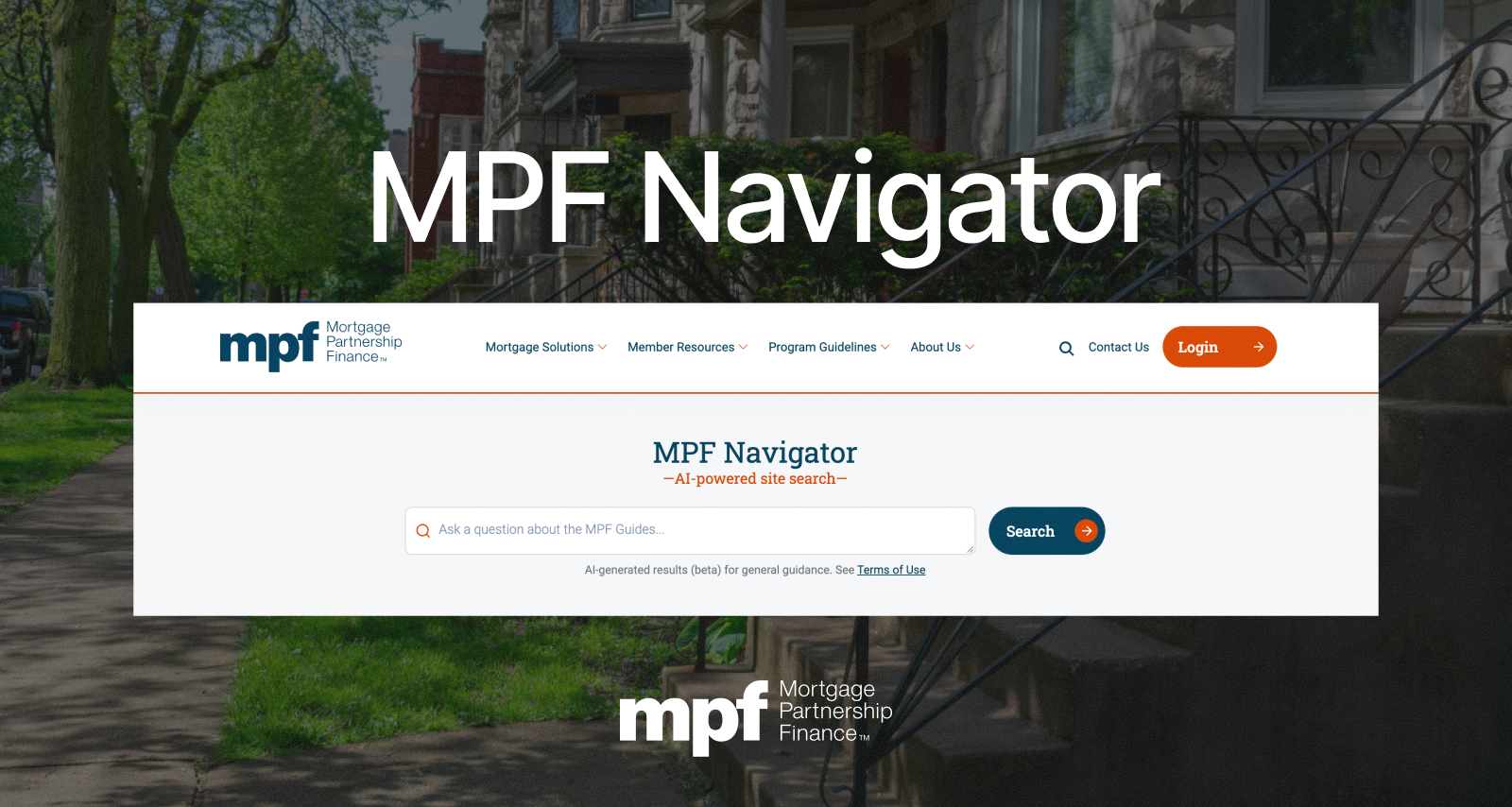
Finding the right program guidance should not require users to know the exact document, section title, or search term before they begin.
That is the problem MPF Navigator was built to solve.
Spinutech partnered with the Federal Home Loan Bank of Chicago to implement MPF Navigator, a new AI-powered search experience for the Mortgage Partnership Finance® (MPF®) Program. The MPF Program allows community financial institutions like local banks and credit unions to sell their residential fixed-rate mortgage loans directly to their regional FHLBank. The MPF Navigator enables users to ask questions in everyday language and receive relevant information based on MPF Program Guide content.
For participating financial institutions, servicers, and other MPF Program users, that means less time searching through guide materials and more time getting to the information they need.
What is MPF Navigator?
MPF Navigator is an AI-powered search tool designed to help users find information within MPF Guide content faster and more naturally.
Instead of relying only on keyword searches or manually opening multiple guide documents, users can ask a question in plain language. MPF Navigator then returns an AI-generated response based on relevant MPF Guide content, along with source references for general guidance.
The feature currently appears within the MPF Guides section, where users can access program and product-specific requirements, servicing guidance, forms, exhibits, and related resources.
The experience is intentionally focused: MPF Navigator is designed to answer questions based on MPF Guide content. If a question falls outside that scope, the tool is built to guide users back toward relevant guide-related queries.
Why AI-Powered Search Matters for Complex Website Content
AI-powered site search is most valuable when users are working with dense, high-stakes information.
The MPF Guides include detailed requirements and processes that participating financial institutions must follow to participate in the MPF Program. That type of content is essential, but it can also be difficult to navigate when a user has a specific question and does not know exactly where the answer lives.
Traditional search is useful when users know the right keyword. AI-powered search helps when users know the question but not the terminology.
That distinction matters. A user may not search using the exact language found in a guide. They may ask a natural question, describe a scenario, or look for a requirement without knowing the official section title. MPF Navigator helps bridge that gap by connecting everyday language to the structured guide content behind the experience.
How Spinutech Helped Bring the Experience to Life
Spinutech’s role was to help turn an AI search opportunity into a practical, usable feature within the existing MPF website experience.
The implementation combines existing search infrastructure with a large language model (LLM) provider. The project team used Algolia as the retrieval layer for indexed guide content and Amazon Bedrock as the large language model provider. Algolia helps identify relevant documents and content, while the language model helps generate a conversational response from that retrieved information.
That type of implementation requires more than placing a chatbot on a page. For an AI-powered search experience to be useful, the system needs the right content foundation, the right retrieval logic, and the right guardrails around how responses are generated.
Spinutech helped support:
- API integration between the search experience and underlying systems.
- Conversational back-and-forth within the MPF Navigator interface.
- Retrieval logic connected to MPF Guide content.
- Prompting and guardrails designed to support accuracy and relevance.
- Front-end implementation that fits the MPF website experience.
- A modal-based interface customized to align with the existing guide search design.
The result is a search experience that feels approachable to users while relying on structured technical work behind the scenes.
The Real Challenge: Making AI Useful, Accurate, and On Brand
Launching an AI-powered search feature is not just a technical challenge. It is an experience challenge.
Users need the tool to feel simple. The organization needs it to be accurate, controlled, and aligned with the existing website. Those goals can work against each other if the implementation is not handled carefully.
For MPF Navigator, the team needed to preserve the clarity of the MPF Guides experience while introducing a new conversational search pattern. That meant creating an interface that felt familiar enough to use immediately, but distinct enough to signal that users could ask questions in natural language.
Accuracy was also central to the implementation. AI search experiences are only valuable when they are grounded in the right content. MPF Navigator was designed around MPF Guide content, with source references included so users can understand where responses are coming from.
For organizations exploring AI-powered search, this is one of the most important lessons: The quality of the experience depends on the quality of the retrieval system, the content being searched, and the rules that shape the response.
A Focused First Step With Room to Grow
MPF Navigator launched as a focused guide search experience, but the long-term opportunity is broader.
Today, the feature is centered on helping users search MPF Guide content. Future enhancements could expand how AI-powered search supports the broader MPF website experience, including deeper integration with sitewide search, suggested prompts, recent searches, and additional content types.
That phased approach is often the right way to introduce AI into a digital experience. Start with a clear use case. Define the content scope. Build user trust. Then expand once the organization has a stronger understanding of how people use the tool and where it can provide the most value.
AI works best when it is attached to a real user problem. MPF Navigator is a strong example because the use case is specific, practical, and tied to a high-value content need.
What Other Organizations Can Learn From MPF Navigator
MPF Navigator shows how AI-powered search can make complex content easier to use without replacing the source material itself.
For organizations, like local banks and credit unions, with large resource libraries, documentation centers, technical guides, policy content, or customer support materials, the opportunity is clear. AI can help users move from “Where do I look?” to “Here is the information that appears most relevant to my question.”
But successful implementation depends on strategy. Organizations, like financial institutions, should start by asking:
- What content set should the AI experience use?
- What questions are users already trying to answer?
- Where does traditional keyword search fall short?
- What guardrails are needed to protect accuracy and trust?
- How should the experience fit into the existing website?
- What should happen when the system cannot confidently answer?
Those questions matter because AI-powered search should not be treated as a novelty. It should be treated as part of the user experience, content strategy, and technical architecture of the website.
AI Search Should Make Complex Content Easier to Act On
MPF Navigator helps users ask natural questions and find relevant MPF Guide information faster. More importantly, it shows how AI can be applied in a practical way on a complex website.
For Spinutech, this project reflects where digital experience is headed. Search is becoming more conversational. Content needs to be structured for both people and AI systems. And organizations need implementation partners who can connect strategy, usability, technical integration, and trust.
AI-powered search is not valuable because it feels new. It is valuable when it helps users get to the right information with less friction.
MPF Navigator does exactly that.
If you're ready to bring the value of AI-powered search to your website, let’s talk.