How to 'Rank' in ChatGPT, Perplexity, and Google AI Overviews
Published by Spinutech on June 4, 2026
AI search platforms now shape a meaningful share of how people find information, compare options, and decide which brands deserve a closer look. Google AI Overviews, Google’s AI-generated answers at the top of some search results, are only one piece of that shift. ChatGPT, Perplexity, and other answer engines are changing discovery too.
“Ranking” in AI search doesn’t mean holding a single blue-link position. It means earning visibility inside AI-generated answers, citations, summaries, and brand mentions. For brands adapting from SEO to AI search, the practical question is no longer limited to “Where do we rank?” It’s also “Are we trusted enough to be included?”
Why “Ranking” in AI Search Is Different From Traditional SEO
From Positions to Citations and Brand Mentions
Traditional SEO measures visibility through rankings, impressions, clicks, and traffic. AI search adds a different layer. Your brand may appear as a cited source, a recommended option, a supporting reference, or a named entity inside a synthesized answer.
That means visibility now includes:
- Citation presence in AI-generated answers
- Brand mentions with or without a link
- Sentiment around those mentions
- Frequency across prompts and platforms
- Inclusion in comparison-style answers
Rank tracking still matters, but it doesn’t tell the full story. A page can rank well and still get excluded from an AI answer if the content isn’t clear, credible, or easy to extract.
Each AI Platform Has Its Own Selection Logic
ChatGPT, Perplexity, and Google AI Overviews don’t gather and present information the same way. Google layers AI summaries on top of its search ecosystem. Perplexity builds citation-first answers from indexed sources. ChatGPT can synthesize from web results, known entities, third-party mentions, and cited pages when browsing is active.
A one-size-fits-all approach won’t work because every platform weighs sources, context, freshness, and authority differently. Your content strategy needs strong owned content, but your broader web presence is important too.
What Traditional SEO Still Earns You in AI Search
AI search optimization doesn’t replace SEO. It builds on it. Crawlability, technical health, structured content, topical authority, and trustworthy writing still create the foundation AI systems need to find, interpret, and reference your content. Strong SEO rankings can’t be discounted because AI search often depends on the same signals that help search engines understand your site. As we’ve covered in our guide to what AI Overviews mean for SEO, the brands that adapt best refine their fundamentals for a new search environment instead of discarding them entirely.
How to Rank in Google AI Overviews
How AI Overviews Actually Work
AI Overviews summarize answers from sources Google considers useful for a query. The result often blends traditional ranking signals with AI-generated synthesis, so your content needs to perform for search engines and answer engines at the same time.
Google may pull from pages that already rank well, but visibility isn’t always a one-to-one reflection of organic position. Clear answers, strong authority, and content that directly satisfies intent can help a page become easier to cite.
Favorable Content Formats That Get Pulled Into AI Overviews
Content that’s easy to summarize tends to have an advantage. Think direct explanations, clean headings, concise answers, useful definitions, and high-funnel informational content that addresses the question without burying the answer.
Strong formats include:
- Direct question-and-answer sections
- Short definitions near the top of a section
- Comparison tables
- Step-by-step explainers
- Topic clusters that build authority around related questions
High-quality content marketing plays a major role here because AI Overviews need clear, useful material to summarize.
The Importance of E-E-A-T, Schema, and Authority Signals
E-E-A-T stands for experience, expertise, authoritativeness, and trust. These signals help users and search systems understand why your content deserves confidence.
Schema adds another layer. FAQ, Article, Product, Organization, and How To schema can help search engines interpret what’s on the page. Clean technical execution matters too, which is why technical SEO remains central to any serious AI search strategy.
How to Rank in ChatGPT and Perplexity
How ChatGPT Selects and Cites Sources
ChatGPT doesn’t surface brands the same way a traditional search results page does. ChatGPT’s web search behavior can favor authoritative publications, established domains, Wikipedia, Reddit, review platforms, and trusted third-party sites when those sources help answer a prompt.
Owned content still has a role, but brand mention frequency is a factor too. If your brand appears consistently and positively across credible third-party sources, ChatGPT has more evidence to associate your brand with specific topics.
How Perplexity Pulls and Presents Sources
Perplexity is built around citations, which makes source selection more visible. It pulls information into answers and shows users where key claims came from.
To optimize for direct citation extraction, write sections that can stand alone. Avoid vague introductions before the real answer. Put the useful explanation near the top, support it with context, and make the page easy to scan.
What Works Across Both ChatGPT and Perplexity
Both platforms reward clarity and corroboration. Strong owned content helps, but off-site validation strengthens the story.
The shared playbook includes:
- Authoritative third-party mentions
- Consistent brand descriptions across the web
- Citation-friendly paragraphs
- Clear topic ownership
- Digital PR that earns credible references
AI Search Optimization Tactics That Work Across Every Platform
Passage-Level Content Optimization
A self-contained answer is a short, clear explanation that makes sense even when pulled out of the full page. AI engines need that kind of passage because they summarize in pieces.
Place direct answers near the top of relevant sections, then expand with examples, nuance, or supporting details. Don’t make the reader or the model hunt for the point.
Brand Mentions, Digital PR, and a Consistent Web Presence
AI engines don’t only look at what you say about yourself. They also consider what the wider web says about you.
Earned media, strong reviews, consistent profiles, Reddit mentions, reputable directories, and industry references all contribute to brand visibility. The more consistent your presence, the easier it becomes for answer engines to understand who you are, what you do, and where you fit.
Structured Data and Machine-Readable Content
Machine-readability is now an optimization layer. Clean header hierarchy, semantic HTML, descriptive anchor text, and structured data help both search engines and AI systems process your content.
As AI search matures, brands need content that’s written for people and organized for machines. Our article on winning visibility in AI-driven search covers more ways to make content easier for AI systems to interpret and cite.
How to Measure Your Visibility in AI Search
The Tools and Metrics To Focus On
Traditional ranking trackers weren’t built for AI citations. They’re still useful, but they can’t fully show how often your brand appears in generated answers, so you’ll need to track a broader mix of signals:
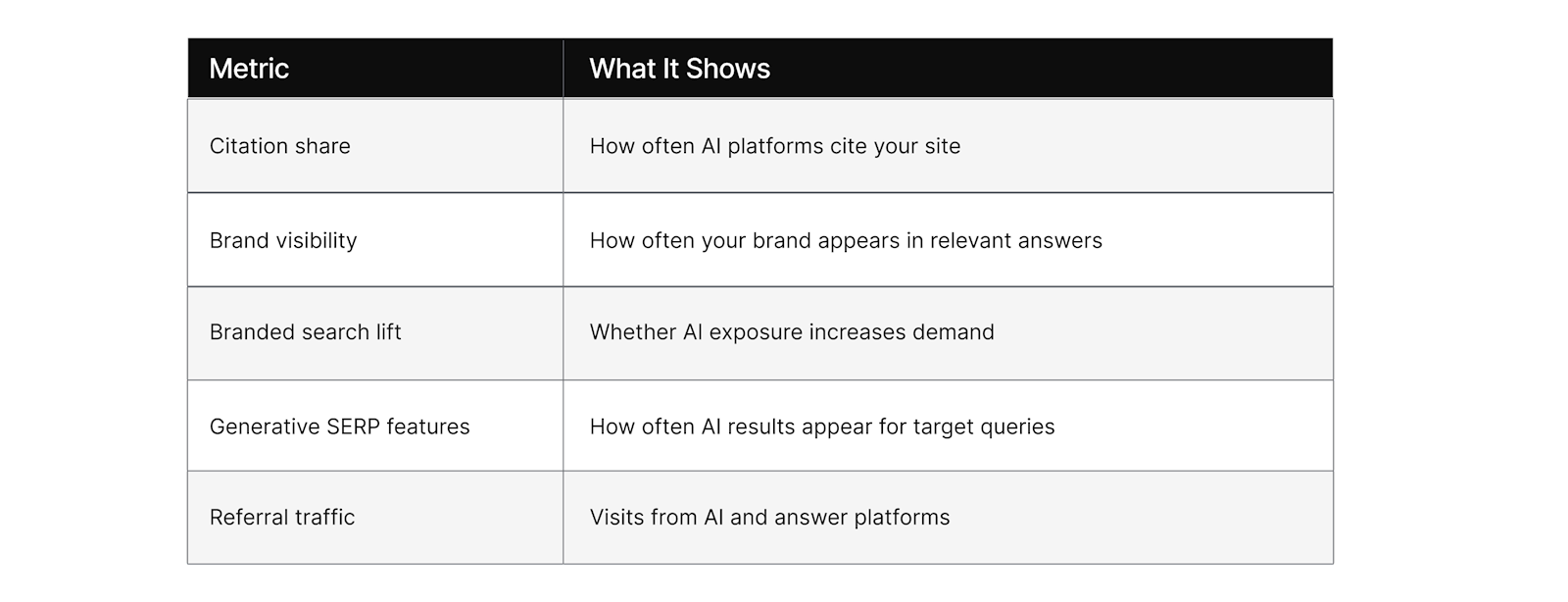
SEO platforms like Ahrefs and SEMrush, along with GA4 and Search Console, can help monitor parts of this picture. Dedicated AI reporting can connect these signals to business outcomes with more clarity.
AI Visibility Belongs to Brands That Show Up Consistently
AI search visibility comes from four pillars: a strong SEO foundation, platform-specific tactics, clear content built for extraction, and measurement that goes beyond rankings. None of this happens through a one-time fix. It takes ongoing optimization, stronger content structure, better authority signals, and a web presence that reinforces the same story across sources.
If you’re ready to improve how your brand appears across AI search, our generative engine optimization services can help you build a strategy for the way search works now. Let’s talk about strengthening your visibility across Google AI Overviews, ChatGPT, Perplexity, and the next generation of answer engines.