How to Choose an Email Marketing Agency
Published by Spinutech on June 2, 2026
Email marketing deserves a place in your marketing strategy because it reaches people in a channel they check frequently, control directly, and rely on to make decisions.
But the channel has evolved.
Strong email programs now depend on far more than writing and sending campaigns. They require strategy, audience segmentation, automation, creative testing, deliverability management, compliance, and clear revenue attribution.
That raises the stakes when choosing an agency partner. You’re not looking for someone to simply execute campaigns. You’re looking for a team that can connect audience data, customer journeys, creative strategy, and business goals into a system that learns, improves, and drives measurable results over time.
If you’re evaluating email marketing services, this guide will help you identify the partners that can deliver real business impact — and avoid getting distracted by polished pitch decks or vague promises.
Identify What Your Email Program Needs Next
Get Clarity on What You Want Email Marketing to Accomplish
A clear goal gives you a better way to judge every conversation, proposal, and recommendation. Without one, most agencies will sound similar because “better campaigns” can mean almost anything.
Start by identifying the real reason you need help:
- Your existing subscriber list isn’t reaching its revenue potential.
- Key lifecycle moments aren’t supported by welcome, nurture, cart, post-purchase, or win-back flows.
- Deliverability issues are keeping strong campaigns from reaching the inbox.
- A platform migration is creating technical, data, or workflow uncertainty.
- Reporting doesn’t clearly connect email performance to business value.
- Your internal team is at capacity and can’t manage strategy and execution without support.
Choose the Operating Model That Fits Your Business
The right goal also helps you choose the right working model. Some teams need a fully outsourced partner. Others need help around a strong in-house marketer. Many growing brands fall somewhere in between, with internal stakeholders owning customer, product, and sales knowledge while the agency brings specialized strategy, creative, platform, and analytics support.
Taking a hybrid approach works well because it doesn’t force your team to choose between control and expertise. You keep the context. The agency adds depth.
Evaluate What a Full Service Email Marketing Agency Should Deliver
A Full-Stack Team You Can Rely On
A full service email marketing agency should give you more than campaign production. At minimum, you should look for a team that can cover the strategic, creative, technical, and analytical sides of the channel.
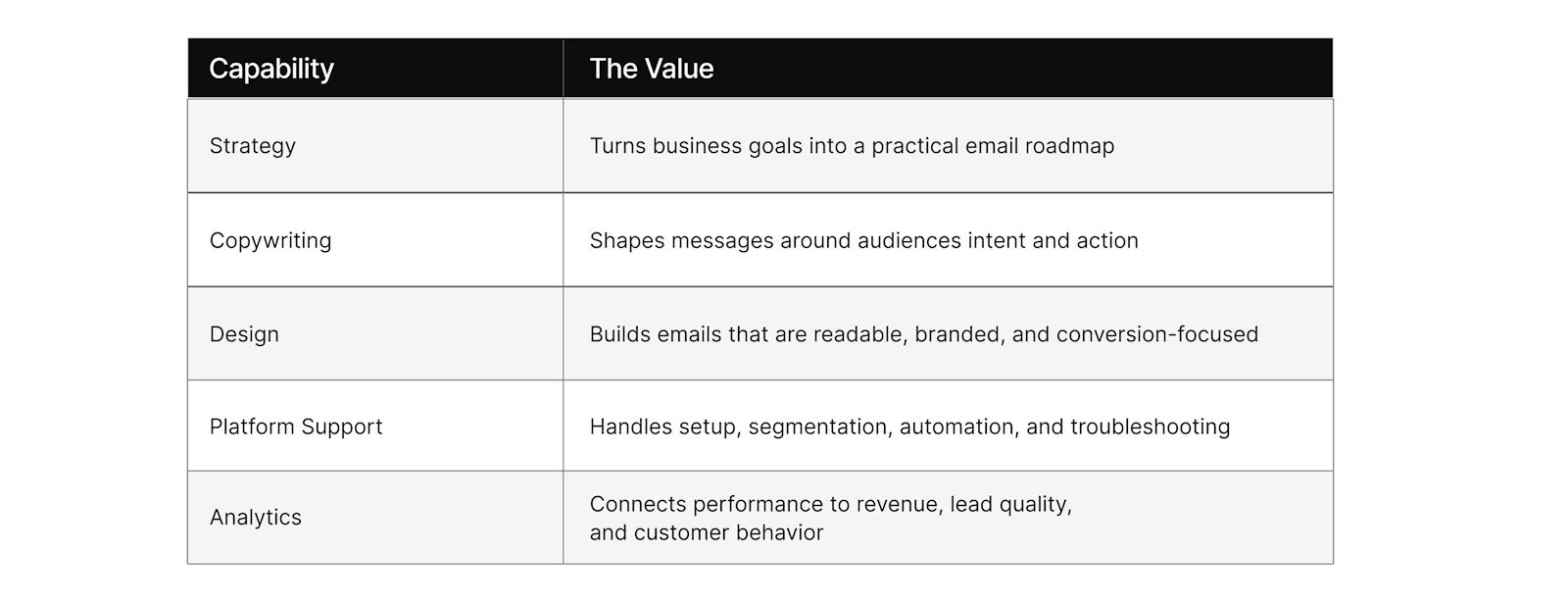
Adding structure creates consistency once your program moves beyond basic batch sends. Freelancers and generalist teams can help with isolated production, but they often hit capacity walls when you need lifecycle mapping, testing plans, CRM logic, or platform cleanup.
For brands trying to get more from customer data, CRM and campaign management helps turn a subscriber list into a more useful relationship engine. The output is stronger when your campaigns reflect what people have done, what they’ve shown interest in, and what they’re likely to need next.
Automation, Segmentation, and Lifecycle Marketing
The best email programs don’t rely on one-off sends alone. They use automation and segmentation to stay relevant across the customer journey.
That can include:
- Welcome flows that introduce the brand and guide first action
- Abandoned cart emails that bring high-intent shoppers back
- Browse abandonment emails that respond to product interest
- Post-purchase emails that support retention, reviews, or cross-sells
- Win-back campaigns that re-engage inactive subscribers
- Lead nurture sequences that support longer B2B buying cycles
A partner with real marketing automation experience can help you decide which flows deserve priority, how each message should change by audience segment, and where automation can remove manual work without making the experience feel impersonal.
Segmentation is the lever that separates flat sends from stronger campaigns. A sale announcement may perform one way with recent buyers and another way with inactive subscribers. A lead nurture email may need different framing for an executive than it does for a technical evaluator. Better segmentation gives every message a sharper focus.
Deliverability, Compliance, and Revenue Reporting
Email performance starts before anyone opens the message. If your emails don’t reach the inbox, the offer, design, and copy can’t do their jobs.
A strong agency should understand the technical and compliance pieces that affect deliverability, including SPF, DKIM, DMARC, list hygiene, unsubscribe behavior, spam complaints, and sender reputation. Gmail and Yahoo sender requirements have also made authentication and sending practices harder to ignore.
Open rates and click rates still offer useful signals, but they don’t tell the whole story. Revenue, qualified leads, repeat purchases, retention, conversion assists, and customer movement across the funnel matter more than vanity metrics by themselves. When your existing email funnel connects with stronger data and analytics, your team can see what’s working, what’s stuck, and what needs to change next.
What Sets the Best Email Marketing Agency Apart?
Strategic Thinking Over Template Sending
Template sending asks, “What email do we need to get out this week?” Strategic email marketing asks better questions:
- Who are we trying to move?
- What does this audience already know or believe?
- What action should this email create?
- Where does this message fit in the customer journey?
- What should we test, measure, or learn from the send?
The answers to each of these questions offer new insight. Strong email programs build trust over time by sending messages that are useful, timely, and specific. That’s especially important when your goal is to build credibility rather than simply fill inbox space.
Proof should go deeper than logo walls, too. Recognizable brands can create confidence, but they don’t explain how the agency thinks. Look for case studies, references, and performance stories that include the challenge, the strategic decision, and the result. Numbers are more compelling when the agency can explain what caused them.
Industry Experience and Proven Marketing Outcomes
The best email marketing agency for one company may not be the right fit for another. Industry experience matters because different business models need different playbooks.
An eCommerce program may focus on product discovery, purchase timing, cart recovery, repeat orders, and loyalty. A B2B program may depend on lead nurturing, sales enablement, educational content, and longer consideration cycles. A service business may need local relevance, appointment intent, review generation, and follow-up sequences that support the sales team.
Still, the better test is whether the agency understands your audience, revenue model, sales cycle, and internal capacity. Ask how they’d adjust strategy based on your business type. A strong answer should be specific. A weak answer will sound like the same campaign calendar could work for everyone.
An Email Marketing Team That Scales With Your Business
Your email needs today may not match your email needs six months from now. A smaller program may start with campaign planning, a few core automations, and cleaner reporting. As the channel matures, you may need more advanced segmentation, deeper lifecycle strategy, deliverability support, creative testing, platform consulting, or stronger connections with your sales and CRM systems.
That’s where team depth matters. A scalable agency can flex in the right specialists as your program grows instead of forcing every new need through the same person or the same limited process.
How to Rate an Email Marketing Agency Partnership
Communication and Responsiveness
The sales process gives you a preview of the working relationship. Notice how the agency communicates while you’re still evaluating them.
Strong signs include direct answers, thoughtful follow-up questions, clear scope details, and realistic expectations. Be careful with broad promises, rushed recommendations, or answers that never move past generalities.
Pricing Transparency
Pricing should be easy to understand. You’ll want clarity around:
- What’s included in the monthly scope
- How many campaigns, flows, or strategy sessions are covered
- What platform work is included
- What counts as an added cost
- How reporting, testing, and optimization are handled
- Who you’ll work with day to day
Lower-cost engagements may cover light production or basic management. Larger programs may include lifecycle strategy, advanced segmentation, deliverability support, platform consulting, creative testing, and deeper analysis. Neither structure is automatically better. The right one depends on the size of the opportunity and the support your team needs.
Reporting Cadence and How Success Gets Measured
A dashboard can show numbers. A useful report explains what those numbers mean.
Weekly reporting may help active teams track current campaigns and quick optimizations. Monthly reporting should show trends, wins, misses, and next steps. Quarterly reviews should pull back further and connect email performance to larger business goals.
The strongest reports answer three questions:
- What happened?
- Why did it happen?
- What are we doing next?
That last question is the most critical. Reporting should create momentum, not just documentation. If an agency can’t explain what it learned from the data, it’ll struggle to improve the program over time.
How the Right Email Marketing Agency Amplifies Your Full Marketing Funnel
Email produces better results when it doesn’t operate in a vacuum. Paid campaigns can introduce new audiences, but email helps nurture them after the first click. SEO can earn qualified traffic, while email keeps those visitors connected after they subscribe. Content can educate prospects, and email can place that content in front of the right audience at the right time.
That’s why your agency should understand how email supports paid media, SEO, and content marketing. A stronger email program can follow up on lead magnets, promote resources, re-engage past buyers, support sales conversations, and keep the audience moving after another channel earns the first interaction.
When all of those pieces connect through a clear digital marketing strategy, email becomes more than a retention channel. It becomes part of a focused system that amplifies your entire marketing operation.
The Right Email Marketing Partner Is a Long-Term Investment
Choosing an email marketing agency comes down to a practical sequence: define the goal, choose the working model, evaluate the service depth, look for strategic thinking, and vet the relationship you’ll experience after the proposal is signed.
The right partner won’t be a vendor waiting for tasks. It should feel like a team that can help you build, scale, repair, and optimize your program with the right mix of strategy, execution, technical oversight, and reporting.
If your team is ready to get more from email, we’re ready to help you find the next move. Let’s talk about building an email program that reaches the right people, sends with purpose, and supports the rest of your marketing strategy.