How to Choose a Digital Marketing Agency
Published by Spinutech on February 19, 2026

Choosing the right digital marketing agency can accelerate growth faster than almost any other decision you make. Choosing the wrong one costs time, money, and focus — often months of lost momentum and learning.
Ignore the flashiest pitch deck. Look for the agency that knows how to turn marketing into measurable business outcomes, with clarity you can defend and results you can build on.
3 Decisions to Make Before Choosing a Marketing Agency
If you can’t answer these questions, you’re not ready to hire yet. Entering an agency relationship without clarity on your business needs is how teams end up buying vibes instead of value.
A strong agency will help sharpen your answers. But you need a clear starting point before anyone starts talking tactics.
1. What outcome matters most in the next 90 days?
One of the biggest mistakes companies make is asking an agency to “improve marketing” without defining what improvement actually means. Growth doesn’t look the same for everyone, and it doesn’t happen everywhere at once.
For the next 90 days, one outcome needs to matter more than the rest. That might be pipeline growth, revenue, qualified leads, eCommerce sales, retention, store visits, or brand lift. The key is choosing one primary objective and letting everything else support it.
Strong agencies know about sequencing, so they understand that chasing brand lift while sales is starving, or maximizing lead volume without regard for quality, creates more problems than it solves. When an agency pushes you to prioritize instead of promising everything at once, that’s a good sign. It means they’re thinking strategically about long-term performance.
2. What’s the constraint?
Every business has friction, so it’s a mistake to pretend it doesn’t exist.
Maybe the budget is tight. Maybe tracking and attribution are unreliable. Maybe your conversion rate is weak, your sales cycle is long, or your internal team is stretched thin. Some organizations don’t have development resources. Others lack creative support. None of this is unusual.
What matters is whether an agency addresses these issues or just skips past them.
Strategy only works when it accounts for reality, so agencies that immediately jump to channels and tactics without addressing constraints are building plans that look good on paper and fall apart in execution. The best partners treat constraints as strategic inputs, not inconvenient footnotes.
3. Do you need a doer or a strategic partner?
This decision shapes everything that comes next.
Some companies just need a doer, an executor who follows directions and runs campaigns exactly as instructed. That can work when internal leadership already has a clear strategy, strong measurement, and the bandwidth to manage outcomes closely.
Most growing organizations, however, don’t need another set of hands. They need innovative strategists. Someone who creates the plan, connects marketing to business goals, and owns optimization over time. They don’t just execute tasks; they build systems, pressure-test assumptions, and adapt as performance data comes in.
Spinutech is built for companies that want the second option. We don’t wait for instructions: We help define what success should look like and how to get there.
What to Look for in a Great Agency Partner
Once your internal decisions are clear, evaluating agencies gets simpler. These are the traits that consistently show up in partnerships that actually drive growth.
1. They speak in business terms, not channel jargon
If an agency leads with their service list instead of your business model, that’s a problem.
Great agencies frame everything through the lens of revenue, pipeline, customer quality, and efficiency. They can explain how marketing activity connects to real outcomes, not just surface-level metrics. Channels are tools, not strategies, and the right partner knows the difference.
2. Their process is clear and repeatable
You should never feel unsure about what happens after you sign.
A strong agency can clearly walk you through the first 30 days, including how they approach discovery, measurement, early optimization, and long-term planning. They don’t wing it. They don’t “figure it out as they go.” They’ve done this before, and it shows.
If an agency struggles to explain how they onboard, prioritize, and measure success, you’re not buying expertise. You’re buying experimentation at your expense.
3. They have a strong point of view
A real partner can tell you what they’d prioritize first, what they’d pause or cut, and how they define success in concrete terms. A strong point of view isn’t rigidity — it’s experience-backed judgment and the confidence to use it.
Agencies without opinions often hide behind flexibility. Agencies with opinions take responsibility.
4. They care more about lead quality than volume
The best agencies want to understand your ideal customer profile, deal sizes, and sales cycle. They ask why sales rejects leads and where prospects fall out of the funnel. They know that improving quality sometimes means fewer leads in the short term, and they’re willing to have that conversation upfront.
Marketing that creates more work for sales without generating more revenue isn’t growth. It’s noise.
5. They’re transparent about access and ownership
You should never give up ownership of your ad accounts, analytics platforms, tags, creative assets, landing pages, and data. You should have admin access. Full stop.
If an agency resists transparency or positions control as a favor instead of a standard practice, that’s a sign to walk away. Ownership protects your business long after any agency relationship ends and allows for full transparency.
6. Their receipts match your reality
Case studies should feel familiar, not aspirational.
Look for examples that align with your industry, budget range, sales cycle, and constraints. Then ask deeper questions. What changed? Why did it work? What would they do differently next time?
Agencies worth trusting don’t just show wins. They explain their decisions.
Use this Scorecard to Compare Marketing Agencies
When conversations start to blur together, structure helps. Use this scorecard to evaluate each agency objectively:
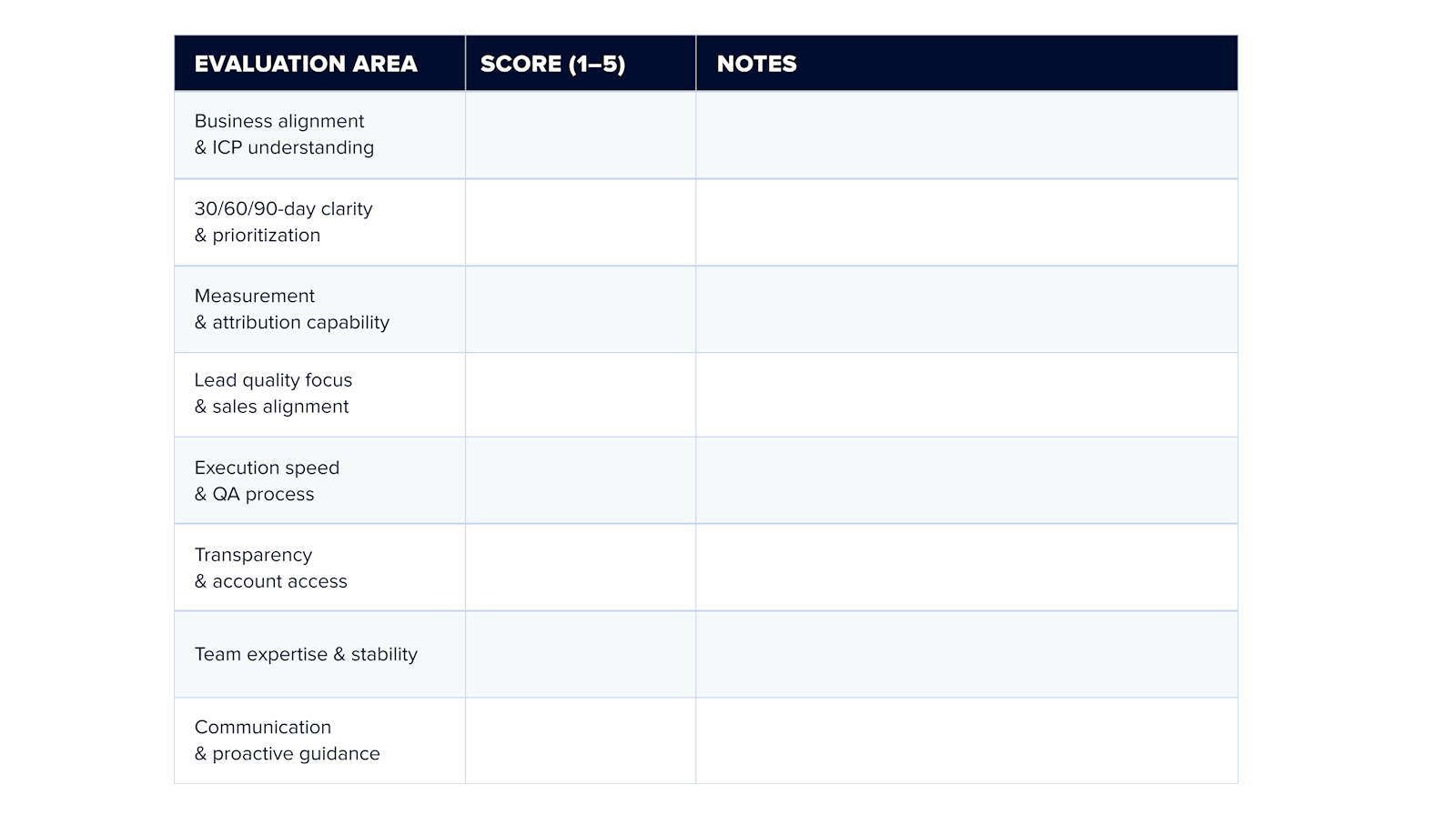
Tip: Anything below a 4 isn’t automatically a deal-breaker, but repeated low scores are a pattern worth paying attention to.
The Questions That Separate Real Partners from Pitch Decks
The right questions reveal how an agency actually thinks about systems, outcomes, and accountability. Ask how they prioritize the first 30 days. How they define and measure success. How they respond when performance slips. How they work with sales.
The answers will tell you whether you’re talking to a true partner—or just a strong presenter.
Ready to Choose Better?
It’s time to build a marketing strategy that works as hard as you do.