How to Know When You Need Custom Website Development
Published by Spinutech on October 1, 2026
Most companies inherit this decision from whoever built their last site. One vendor sells custom development, another reaches for a template, and the business spends the next four years living with the consequences.
Neither option wins by default. Paying for custom because it sounds more serious can waste money. Choosing a template because the launch price looks lower can create years of manual work behind the scenes.
The better comparison is fit over the life of the site. Custom website development earns its keep when it supports workflows your team can’t reasonably fit into an existing structure. Plenty of businesses will never need that level of customization.
Key Takeaways
- Most companies need customization in specific places rather than a completely custom build
- Workflow problems are a stronger warning sign than visual limitations
- Plugins and manual work can erase the savings of a cheaper launch
- Custom CMS development can sit on top of a proven platform
- The best choice follows how your team works every week
The Four Options and What Each One Is For
The custom website vs template conversation often gets framed as a two-door decision. Most mid-size businesses have more options.
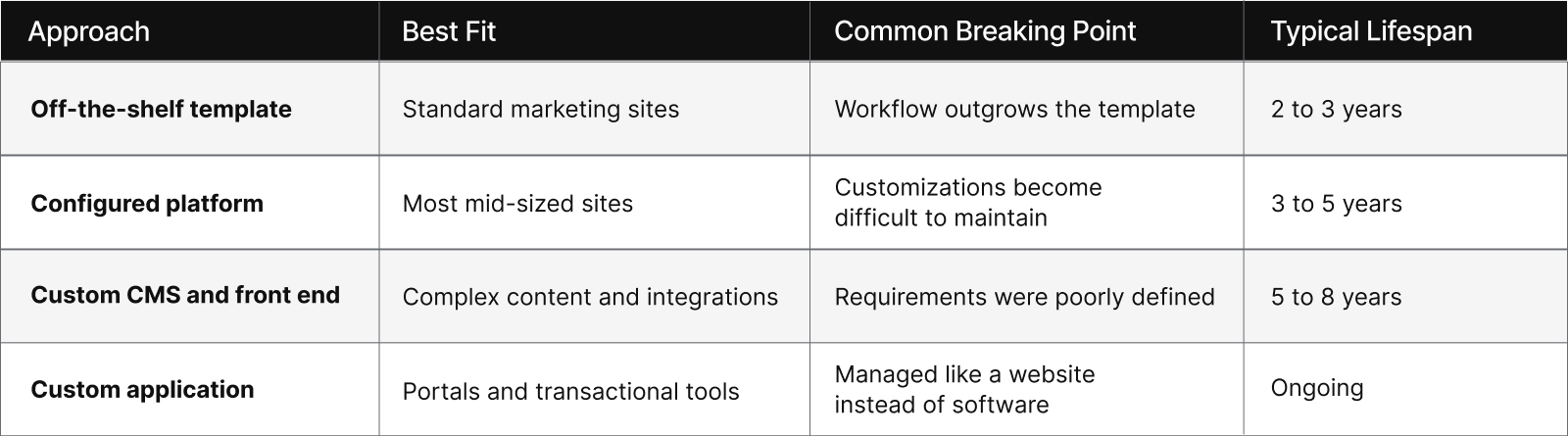
The middle two rows deserve more attention than they usually get. A template replaced in two years may cost more over time than a stronger build that’s still useful six years later.
When a Template Is the Right Call
Many companies can skip custom web development entirely.
A template fits well when your site uses familiar content patterns and a small team handles updates. It also makes sense when speed is the priority and the website has few connections to outside systems.
Here’s the simplest test. If your team can publish everything it needs without fighting the CMS, the platform is doing its job.
The tradeoff comes later if your needs change. Templates carry assumptions about how information should be structured, and changing those assumptions can become surprisingly expensive.
5 Signs You’ve Outgrown a Template
1. Your Team Works Around the CMS More Than in It
Editors start forcing content into the wrong page type or relying on HTML blocks to get routine work done. Eventually, one person becomes the unofficial keeper of publishing knowledge.
Those workarounds have a cost even when they never appear on an invoice.
2. Your Content Model Doesn’t Match How You Organize Information
A page and a structured content type solve different problems. If your company manages locations or staff as disconnected pages, updating the same information across several places can become a recurring chore.
Custom content modeling creates a reusable source instead of another copy-and-paste job.
3. Every Integration Is a Plugin
Plugins can solve useful problems, but each new dependency adds another point your team has to maintain. Website maintenance gets uncomfortable once nobody can confidently explain what an update might break.
At some point, the stack starts carrying more patches than platform.
4. Performance Problems Trace Back to Code You Don’t Use
Templates are built for a broad audience, so they often ship with functionality your site never touches. Your users can still end up downloading some of the weight.
When unused code begins contributing to slow experiences, website performance becomes part of the custom development conversation.
5. Every New Page Type Still Requires a Developer
Templates are often sold as a path toward greater independence. A poor fit can create the opposite result.
Look back at the past year. How many development tickets involved work your CMS was supposed to let an editor handle?
What Custom CMS Development Solves
The biggest payoff often happens behind the website.
Custom CMS development can shape the editing experience around the information your team manages. A marketer updating a staff profile might get clearly defined fields instead of a blank page builder. A content editor can publish within guardrails instead of relying on tribal knowledge.
Purpose-built custom functionality can also remove recurring manual work when the business has a process worth supporting directly.
Maintenance can become simpler too because fewer add-ons mean fewer dependencies. Custom work still needs clear requirements and ongoing ownership. Great code can’t rescue a content strategy nobody defined.
Custom vs Off-the-Shelf Software Uses the Same Test
The decision gets more expensive when the website becomes a portal, calculator, configurator, or internal tool.
Start with the process itself. If your workflow resembles something thousands of other companies already do, buying software someone else maintains may be the smarter move. Custom software makes a stronger case when the process gives your business a genuine advantage.
Integrations often settle the debate. Custom APIs can connect systems when a packaged product reaches its limits, while established CMS integrations may cover common needs without reinventing the wheel.
Questions to Answer Before You Get a Quote
Bring these questions into the internal conversation before choosing an approach.
- How many people publish, and how frequently
- What information do we manage beyond standard pages
- Which systems need to exchange data
- What requests has the current site failed to support
- How long should the next build remain useful
An agency recommending a solution before understanding those answers is working from assumptions.
The Middle Ground Fits More Companies Than You Think
For many mid-size organizations, the right answer is an established CMS platform with custom work focused where it changes the daily experience.
A platform such as WordPress can provide maintained core functionality while custom templates and content models support the needs unique to the business. You pay to solve the parts worth owning and leave commodity functionality to technology built to handle it.
Our approach starts with what the team needs to accomplish each week. The build follows from there.
Frequently Asked Questions
What Is Custom Web Development?
Custom web development creates templates and functionality around the needs of one organization rather than adapting everything to a prebuilt theme.
Is Custom Web Development Worth It?
It can be when routine publishing or business workflows consistently require development help. Straightforward sites with straightforward needs can often spend their budget elsewhere.
What Is the Difference Between a Custom Website and a Template Website?
A template begins with a predetermined structure and fits your content into it. Custom development starts with your needs and builds the structure around them.
Can You Customize a Template Instead?
Yes. For many businesses, customization is the right answer. Problems tend to surface when layers of modification make upgrades fragile and maintenance unpredictable.
What Is Custom CMS Development?
Custom CMS development shapes the editing experience around the content an organization manages, often while using an established platform underneath.
When Should You Choose Custom Software Over Off-the-Shelf?
Choose custom software when the workflow itself creates competitive value or when packaged products can’t support the integrations the process requires.
The Right Build Is the One Your Team Can Live With
This decision looks like a budget question at first. Spend a few years with the website and it starts looking much more like a workflow question.
Sometimes the best answer is a template. Sometimes your team needs a more tailored website development approach. Good advice should lead you toward the smallest build capable of supporting the way your business operates, even when the smaller option costs less.
Trying to decide where your project belongs? Work with us to talk through the build that fits your team now and gives you room for whatever comes next.