How to Choose the Right KPIs for Each Marketing Channel
Published by Spinutech on October 15, 2026

Monthly marketing reports can contain an impressive amount of information and still leave everyone asking the same question. Are we doing well?
The problem usually starts with measurement working backward. Platforms decide which numbers are easiest to export, so those numbers become the report. Useful digital marketing KPIs begin somewhere else. Start with what the business needs to know, then choose the measure capable of answering it.
The marketing KPI examples below show how that changes by channel and how to cut a crowded scorecard down to something your team can use.
Key Takeaways
- A KPI answers a business question while a metric provides context
- Different channels need different definitions of success
- Leading indicators help teams respond before revenue results arrive
- A shorter KPI list creates clearer decisions
- If a number changes and nobody responds differently, it probably belongs outside the primary report
What’s the Difference Between a KPI and a Metric
A metric is any measurable number. A KPI is one of the small number of measures your team has agreed will indicate whether the work is succeeding. The practical test is simple. If the number moved sharply tomorrow, would your team change a decision? If not, it’s probably supporting information.
This distinction between KPIs vs metrics changes the role reporting plays. A KPI creates action while supporting metrics help explain what produced the result.
Leading indicators can give teams time to intervene. Qualified traffic or pipeline creation may reveal direction early in a quarter. Closed revenue confirms the outcome later.
Impressions and follower counts still provide context. Problems begin when movement in those numbers gets treated as proof of business progress.
Start With the Question, Not the Dashboard
Work backward from the decision.
Suppose the objective is generating more high-quality leads. “Are we reaching people who resemble our best customers?” is more useful than immediately opening a lead-volume report. From there, you can identify the measurement capable of answering the question.
Our analytics approach starts in this territory because finding the right question often creates more value than adding another chart.
Measurement gaps deserve attention too. If the signal you need isn’t tracked well, fix the tracking rather than replacing it with an easier number that answers a different question.
Marketing KPI Examples by Channel
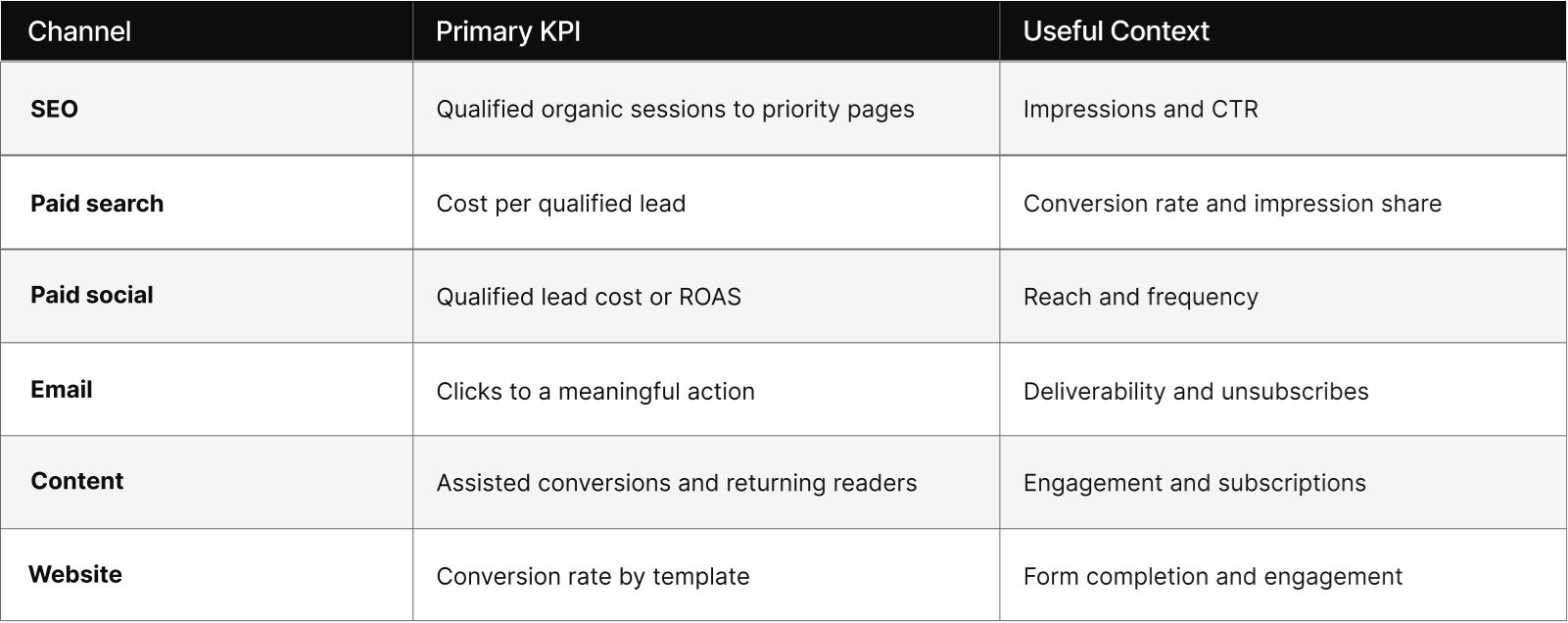
Channels occupy different places in the customer journey. Measuring all of them against the same conversion KPI guarantees a distorted comparison.
What Are the Best KPIs for SEO?
Qualified organic sessions to priority pages provide a stronger primary SEO KPI than rankings alone. Impressions, click-through rate, and indexed-page counts help diagnose performance. Rankings have become less complete as search results diversify, while brand searches can inflate organic totals without showing whether SEO is creating new demand.
Priority pages are the service, product, and conversion destinations connected most closely to revenue. Keyword position can still add context, and our breakdown of SEO keyword rankings explains how to interpret them without turning position into the entire scorecard.
AI answers create another measurement gap because visibility can occur without generating a traditional organic session.
What Are the Best KPIs for Paid Search?
Cost per qualified lead gives paid search a stronger business KPI than plain cost per lead. Impression share, conversion rate, and quality indicators can help explain performance. Impression share is especially useful for separating campaigns constrained by budget from markets where available search demand is simply limited.
Qualified lead measurement depends on CRM data flowing back far enough to connect media with sales quality. Without that connection, the ad platform can optimize toward form submissions without knowing which submissions became useful opportunities.
What Are the Best KPIs for Paid Social?
For direct-response campaigns, cost per qualified lead or ROAS can anchor measurement. Awareness campaigns need a different lens built around reach, frequency, and new audience exposure. Judging awareness work on last-click conversions can make useful demand-building campaigns look inefficient simply because another channel captures the eventual conversion.
Our approach to paid social measurement starts with the campaign objective for this reason.
Platform-reported conversions remain useful for campaign optimization. Central analytics should handle cross-channel comparisons because multiple platforms may claim influence over the same sale.
What Are the Best KPIs for Email Marketing?
Clicks toward a meaningful action provide a stronger primary email KPI than opens. Deliverability and unsubscribe rate add useful context around list health. Apple Mail Privacy Protection downloads remote email content in the background, which can register activity without proving that someone opened and read the message.
Meaningful clicks depend on the campaign. A visit to pricing or a completed download can show movement toward the intended outcome. Clicking a logo tells you considerably less.
Connecting email activity to conversion rate takes the analysis another step toward business performance.
What Are the Best KPIs for Content Marketing?
Assisted conversions and returning readers help capture the delayed value of content. Scroll depth, subscriptions, and AI citations can provide supporting context. Pageviews show reach, but they reveal little about whether content influenced a later decision or gave someone a reason to return.
A returning reader suggests the content created enough value for another visit. Assisted conversion data shows where content participated in a journey that eventually produced action. Effective content measurement needs room for those indirect contributions.
What Are the Best KPIs for Your Website?
Conversion rate by page template usually reveals more than one sitewide conversion rate. Averaging every page together can hide a weak service template behind a high-performing campaign landing page. Engagement rate, form completion, and page speed provide useful diagnostic context while behavioral research helps explain why people leave.
GA4 defines engagement rate using engaged sessions, while its bounce rate is the inverse of that measure. An engaged session lasts longer than 10 seconds, records a key event, or reaches at least two page or screen views.
Our thinking on choosing website KPIs and interpreting website analytics goes deeper into that page-level analysis.
Match the KPI to the Job the Channel Is Doing
Awareness investment needs evidence that new people are being reached. Consideration work needs signs of deeper engagement. Decision-stage campaigns can be held closer to conversion and acquisition cost.
Matching the KPI to the assignment prevents a useful channel from getting cut for failing a job it never received.
Cross-channel measurement introduces another problem when several platforms claim the same conversion. Multi-touch attribution can help clarify how different interactions contribute across the journey.
How to Narrow a Long KPI List Into a Usable One
Run a simple exercise with your team this week.
- Write down the business objective each channel supports.
- List every number currently reported for that channel.
- Ask what decision would change if each number moved 20 percent.
- Flag any signal you need but can’t measure reliably yet.
- Give each remaining KPI a target or expected direction.
Most teams finish with fewer measures. The report usually becomes more useful because everyone knows which movement deserves a response.
Where KPIs Go in a Dashboard
Keep the first view focused on the KPIs. Supporting metrics can remain available for diagnosis without competing for leadership’s attention.
A custom analytics dashboard can give channel managers the detail they need while presenting leadership with a tighter view of performance. Reporting also becomes more valuable when analytics expertise extends beyond dashboard delivery.
Frequently Asked Questions
What Is the Difference Between a KPI and a Metric?
A metric is any measurable number. A KPI is a measure the team has selected as evidence of progress toward a defined objective.
How Many KPIs Should Each Channel Have?
Keep the number small enough that your team can name them from memory and explain which decision each one informs.
What Are Good Digital Marketing KPIs?
Good KPIs reflect the channel’s assignment. Awareness work may prioritize qualified reach, while demand capture can focus on qualified lead cost.
Is Open Rate Still a Useful Email KPI?
It can provide context, but privacy features make it unreliable as a primary engagement measure. Clicks and downstream actions provide stronger evidence.
Are Impressions and Followers Vanity Metrics?
They can provide useful context. Their weakness appears when teams treat growth in those numbers as proof of business progress without another outcome behind them.
How Often Should KPIs Change?
Keep the measures relatively stable so trends remain readable. Targets can change as business goals evolve.
Measure Fewer Things and Mean Them
Most marketing teams have plenty of data. Direction is harder to find.
One question cuts through a surprising amount of reporting clutter. Would we do anything differently if this number moved?
We start measurement work by understanding the decision a client needs to make, then build the analysis around it. The platforms can keep producing all the other numbers. They just don’t all need a seat at the main table.
Ready to find out which KPIs deserve one? Work with us to turn your marketing measurement into something your team can use.