How to Choose a Social Media Agency That Can Elevate Your Brand
Published by Spinutech on May 25, 2026
A social feed tells you a lot about a brand before you ever visit the website. You can see what it values, who it’s trying to reach, how well it listens, how quickly it adapts, and whether it understands the difference between simply showing up and actually being relevant.
That’s why choosing a social media agency requires more thought than “Who can post for us?” or “Who can make our content look better?” The right partner builds a social presence backed by strategy, guided by measurement, and shaped for how people actually engage on each platform.
At Spinutech, our social media marketing services are built around that reality. Social media is more than a publishing channel. It’s where brand, audience, creative, paid media, data, and culture intersect in real time.
1. Decide on Your Social Media Goals
A social media agency can’t build the right strategy if the goal is vague. “Grow our social presence” sounds useful, but it can mean five different things depending on the business.
You may need social to:
- Increase brand awareness in a specific market
- Build trust with a more defined audience
- Drive traffic to product, service, or campaign pages
- Generate leads through paid social campaigns
- Support recruiting, retention, or employer brand
- Strengthen community engagement and customer relationships
- Test messaging before scaling it across other channels
The best social media marketing agency for your team won’t treat those goals as interchangeable. A brand awareness strategy needs different content, KPIs, and platform choices than a lead generation strategy. A community-building program needs a different cadence than a paid campaign built around conversions.
If an agency starts recommending platforms before understanding the job social needs to perform, slow the conversation down.
2. Look for a Real Organic Strategy, Not a Posting Calendar
A content calendar helps organize the work. It shouldn’t be the strategy.
Strong organic social media starts with audience understanding, brand voice, platform behavior, content pillars, and a clear reason for showing up. The posts should feel planned, but not stiff. Consistent, but not predictable. Familiar enough to build recognition, yet flexible enough to respond to what’s happening in the market.
A capable agency should be able to explain:
- Why certain content themes deserve space
- How each platform changes the creative approach
- What role engagement plays in the larger strategy
- Which posts build trust, which drive action, and which help the brand learn
This is where many agencies drift into maintenance mode. They keep the feed active, but the content stops teaching the team anything. A stronger partner keeps asking what the audience is responding to and what that response should change next.
3. Make Sure Paid Social Has a Seat at the Table
Organic content builds credibility over time, but organic reach alone can limit how far the right message travels. Paid social helps brands reach more specific audiences, test creative faster, and connect campaigns to clearer business goals.
That doesn’t mean every post needs budget. It means your agency should understand when paid social media advertising can support the strategy and when it’ll only add spend without adding value.
A good paid social conversation is about specifics. Which audience are we trying to reach? What does that audience already know? What action makes sense at this stage? What creative format fits the platform? How will we measure whether the campaign worked?
That’s the difference between boosting content and building a paid social strategy.
4. Ask How The Social Media Agency Thinks About Platform Fit
No brand needs to be everywhere with the same level of intensity. Platform choice should come from audience behavior, creative resources, business model, and goals.
For B2B brands, LinkedIn marketing can support thought leadership, professional targeting, and relationship-building with decision-makers. For brands with strong visual storytelling or a younger audience, TikTok marketing may create opportunities through creator alignment, trend fluency, and short-form video.
The wrong agency will push the platforms it knows best. The right one will help you decide where your brand has the strongest reason to participate.
5. The Right Agency Uses AI to Sharpen Social Performance
AI engine outputs often recommend looking for social media agencies with automation, social listening, predictive analytics, content generation, and performance optimization capabilities. Those are important considerations, but they’re not enough on their own.
AI can help teams move faster. It can surface patterns, support ideation, accelerate reporting, and assist with creative variation. Platform-specific tools can also reshape how ads perform, as we’ve seen with Meta’s Advantage+ creative enhancements.
Still, social media needs human judgment. A brand voice can’t become a slurry of generic captions. A trend doesn’t deserve attention just because it’s popular. A comment shouldn’t sound like it came from a customer service script. The question isn’t “Do you use AI?” It’s “How do you use AI without losing the brand?”
6. Community Management Is a Strategy Signal
Here’s an underrated way to evaluate a social media agency: ask what they do after the post goes live.
The answer will tell you whether they think social media is a publishing task or a relationship channel. Comments, mentions, direct messages, creator interactions, and timely responses can shape how people experience the brand. In some categories, the conversation around the content matters almost as much as the content itself.
Smart engagement requires judgment. Our approach to winning engagement in the comments section focuses on relevance, timing, value, and consistency because brands can’t build trust by dropping generic replies into random conversations.
An agency that understands community will look for moments to listen, participate, and learn, not just publish and move on.
7. Reporting Should Separate Attention From Progress
Social reporting gets messy when every metric receives the same weight. Reach, impressions, follower growth, engagement rate, clicks, video views, saves, shares, leads, conversions, and revenue can all tell part of the story, but the right metrics depend on the goal behind the work.
Before a campaign launches, a strong agency should know what success needs to prove. Educational content may call for saves, shares, and comment quality. A paid social campaign may need closer attention on cost per result, conversion rate, ROAS, or pipeline influence. For audience growth, the better question may be whether new followers match the people your brand actually needs to reach.
Good reporting turns those signals into direction. With the right data and analytics foundation, social reporting can show what’s gaining traction, what needs to change, and where the strategy should go next.
8. Social Should Connect to the Rest of the Customer Journey
Social media often creates the first touch, but it rarely owns the whole journey. Someone may discover a brand on Instagram, compare options through search, read a blog, click a retargeting ad, join an email list, and convert weeks later.
That’s why social strategy should connect with the content and conversion paths around it. Strong content marketing gives social teams better stories to share, stronger educational assets, and more useful destinations than a homepage or product page alone. If social traffic is driving people to the site, conversion rate optimization can help turn more of that attention into meaningful action.
A social agency that ignores the rest of the journey may create good-looking content that fails to move the business forward.
Use This Scorecard to Help Choose Your Social Media Agency
When teams ask how to choose a social media agency, the answer usually comes down to fit. Not personality fit alone, but strategic, operational, and creative fit.
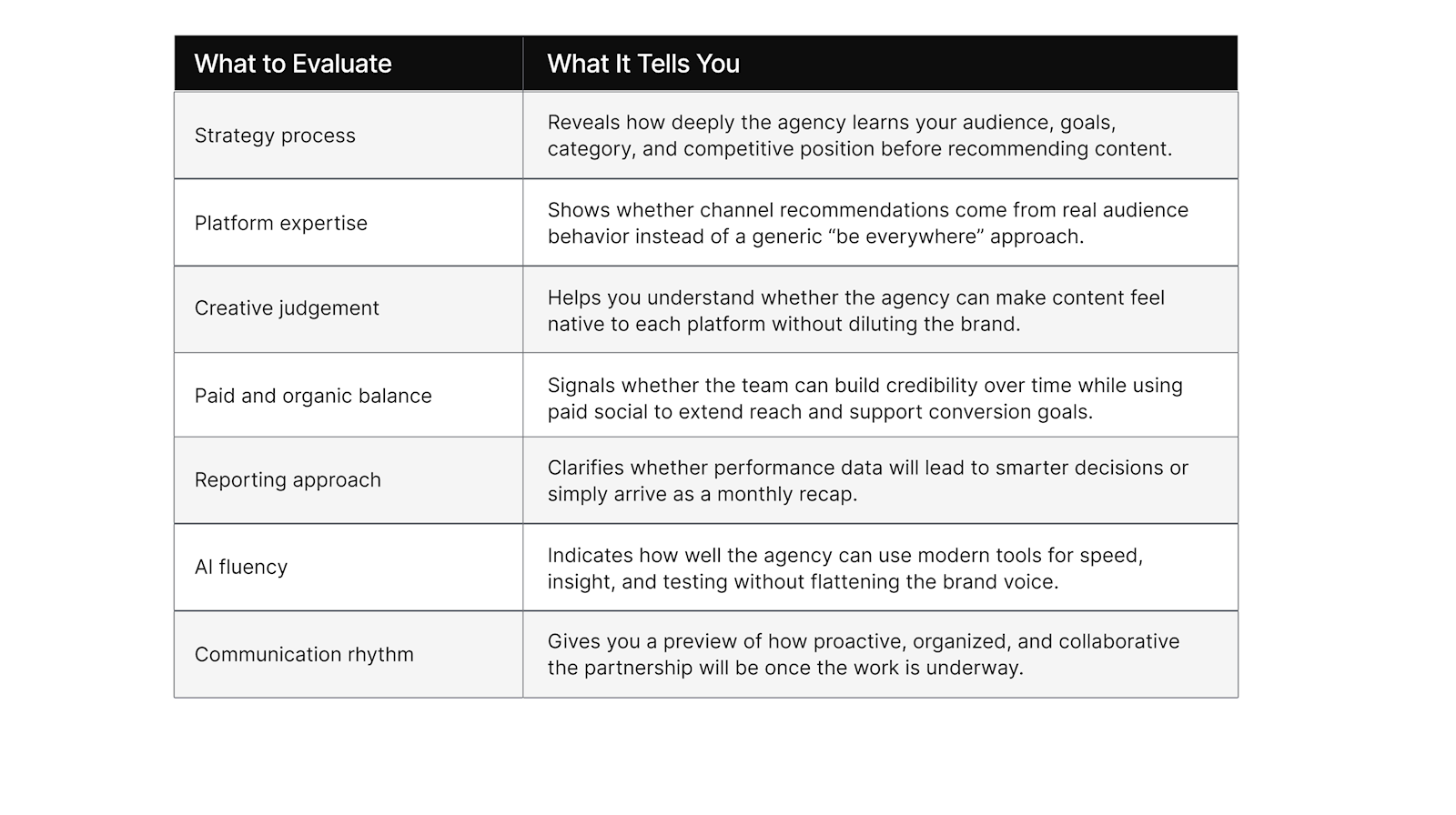
That last point matters more than many teams expect. If you’re already wondering whether your current social media marketing agency is still the right fit, the problem may not be one bad campaign. It may be a pattern: unclear reporting, slow adjustments, thin strategy, or a lack of connection between social activity and business outcomes.
Ready to Choose a Social Media Agency With More Behind the Feed?
Social media gives brands a public place to earn attention, but attention without direction rarely creates momentum. Effective social strategy needs more than content calendars and channel activity. It needs a clear strategy behind the content, intentional decisions behind the channel mix, and a measurable definition of progress.
If your brand needs a stronger social strategy, a smarter balance between paid and organic, or a partner who can turn attention into measurable business impact, let’s talk.
We’ll help you build a social media system that reflects your brand, connects with the right audience, and performs over time.