How to Split Your Paid Social Budget Across Platforms
Published by Spinutech on September 29, 2026
Paid social has become easier to expand and harder to fund well. New platforms and formats create more ways to reach buyers, but every addition asks the same budget to cover more ground.
The allocation decision sets the ceiling for everything that follows. A thoughtful paid social media strategy gives proven channels enough room to perform while protecting space to test what could work next. Here’s how to build that split without spreading the budget into irrelevance.
Use this framework to make those calls for the quarter ahead.
Key Takeaways
- An even split can leave every platform underfunded.
- Each conversion campaign has a practical spending floor based on the signal volume it needs.
- Adding another platform to a flat budget can weaken the channels already producing.
- Qualified conversions should carry more weight than competitor visibility.
- Creative capacity often sets the real limit on how many platforms you can support.
Why an Even Split Underperforms on Every Platform
Equal allocation looks tidy in a spreadsheet. Yet, algorithms have no appreciation for symmetry.
Paid social systems need enough conversion data to learn which people are most likely to respond. When a budget gets divided across too many platforms, campaigns can spend long stretches gathering weak signals instead of reaching stable performance. TikTok, for example, explicitly describes a learning period where performance becomes more stable as results accumulate.
Adding a sixth platform to an unchanged budget can turn one healthy program into six hungry ones. Equal allocation often delays the harder decision about which channels deserve priority. A broader social media marketing plan may span many platforms. Paid investment needs more concentration.
The Framework for Splitting Social Budgets
Set a Floor for Every Platform You Run
Minimum viable spend is the amount needed to generate enough qualified conversion activity for a useful test and stable optimization.
Build the floor from your own economics. Suppose you need roughly 20 qualified conversions to judge a test and your expected CPA is $150. You’d need about $3,000 across the testing window before drawing a serious conclusion.
Your number will vary by objective and platform. Copying someone else’s benchmark ignores your conversion rate and buying cycle.
When a platform can’t clear its floor, better targeting won’t solve the funding problem. Remove it from the active mix and put the money somewhere with enough runway.
Fund the Core Where Your Audience Converts
Most accounts need one core platform, occasionally two, carrying the clear majority of spend.
Historical qualified conversions provide the strongest starting signal. Executive familiarity is weaker. A large organic following can be weaker still.
A B2B company may find LinkedIn advertising expensive on a lead basis but highly efficient once opportunity quality enters the calculation. An ecommerce brand could see the opposite pattern on Facebook. Follow business outcomes farther down the funnel before naming the winner.
Reserve a Test Budget You Don’t Raid
Fragmentation creates a legitimate need to explore. Solve it with a protected testing allocation rather than permanent low-level spending everywhere. A useful test begins with one clear hypothesis and enough budget to reach its minimum floor. Give it a defined evaluation window before making the call.
A new TikTok strategy might test whether native short-form creative can acquire a new audience efficiently. Pinterest could earn a test when research and inspiration play a larger role in the purchase.
Ten to 15 percent of paid social spend is a useful directional starting point for testing, provided the dollars behind that percentage can fund a readable experiment.
What Should Drive Your Paid Social Budget Split
Past qualified conversion performance deserves the first look. Sales cycle and customer value add context because a high CPA can still produce better economics when deal values justify it.
Funnel stage changes the picture as well. Awareness investment has a different job than direct-response spend, so forcing both through the same short-term ROAS lens can distort allocation. Audience presence belongs farther down the decision tree. Plenty of buyers use a platform without buying there.
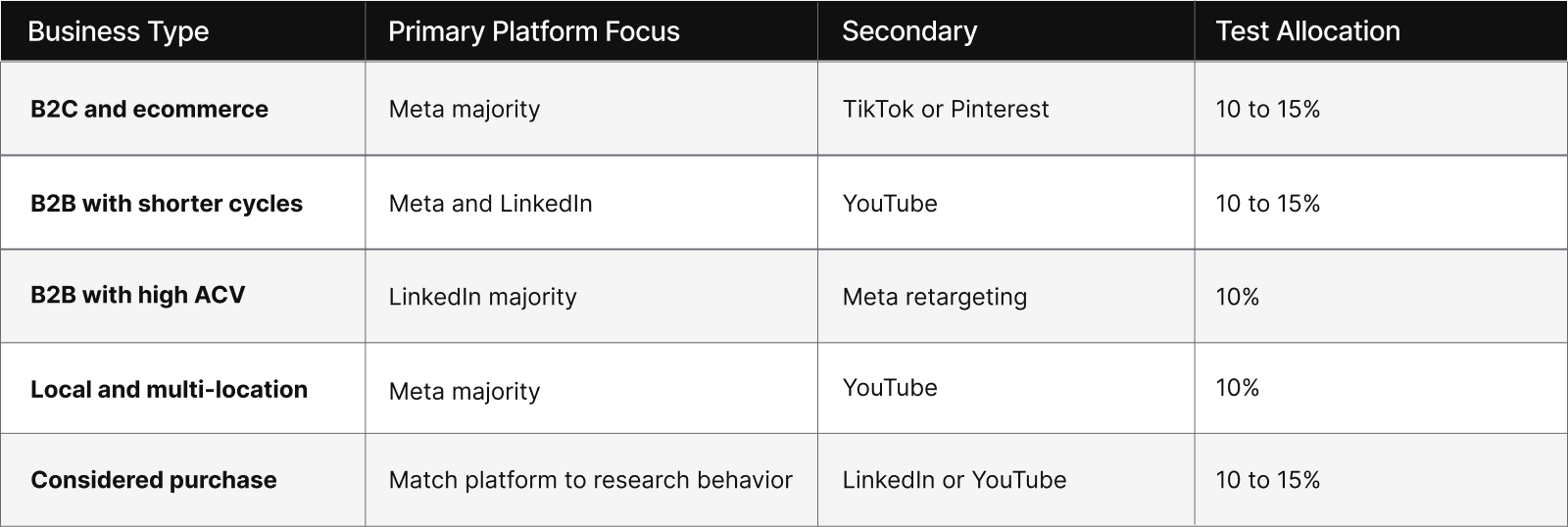
Use the table below as a directional starting point, then replace it with your own performance data.
One more constraint deserves a seat at the table. Creative.
Opening another channel means producing ads suited to its environment. A stretched team recycling the same asset everywhere can hit a creative ceiling long before the media budget runs dry. Building a stronger creative strategy gives each platform enough fresh material to test and scale.
Rebalance on a Cadence, in Increments
Monthly reviews usually create a better decision window than weekly reactions. Social performance moves around, and moving money after every rough week turns optimization into whack-a-mole. Add budget when qualified CPA stays near target and creative performance remains healthy. Pull back after sustained inefficiency has survived meaningful creative testing or when the campaign still can’t generate enough signal to justify its allocation.
Move in increments. Large swings can disrupt delivery and make it harder to understand what caused the next performance change. Annual planning needs room for the same flexibility. Instead of locking every dollar to a named platform for twelve months, allocate around outcomes and preserve a reallocation reserve.
Central marketing analytics also keeps the review honest. Platform-reported conversions can overlap, so each network grading its own homework won’t give leadership a reliable comparison.
Frequently Asked Questions
How Should I Split My Paid Social Budget Across Platforms?
Set a minimum spend for every active platform, give the majority to channels producing qualified conversions, and keep 10 to 15 percent available for structured testing.
Should I Spend Equally Across Platforms?
Usually, no. An even split ignores different acquisition costs and can leave several campaigns without enough conversion volume to learn effectively.
How Many Platforms Should I Run at Once?
Run only as many as you can fund properly and support with native creative. For many mid-market programs, two or three active platforms create a stronger foundation than trying to maintain a thin presence everywhere.
How Often Should I Rebalance?
Review the split monthly and make incremental changes based on qualified conversion economics. Weekly fluctuations rarely deserve wholesale reallocations.
How Do I Know Which Platform Is Working?
Use centralized measurement built around one definition of conversion quality. Platform-reported ROAS is useful inside each system, but cross-platform allocation needs a shared source of truth.
Allocation Is the Strategy
Audience fragmentation won’t be solved by being everywhere. A disciplined paid social media advertising program sets realistic funding floors, backs the strongest channels, and provides enough space to learn what could work next.
Creative capacity and centralized measurement keep the strategy grounded as the mix evolves. Regular rebalancing prevents yesterday’s assumptions from owning next quarter’s budget.
Our paid social media services approach allocation as an ongoing decision with our clients rather than defaulting spend toward whichever platforms are easiest to buy. Want another set of eyes on your current split? Work with us to find where your paid social budget has room to work harder.